


If you don’t know what a customer is worth, you’re guessing
If you don’t know what a customer is worth to your business, every growth decision becomes a guess.
How much should you spend on marketing?
How much can you afford to pay for a lead?
How much should you reinvest into grow?
Most business owners don’t have clear answers.
Which is why they either play too small… or grow in a way that creates pressure on cash flow, delivery, or both.
This is where Customer Lifetime Value changes everything.
Not as a metric.
As a growth lever.
What is Customer Lifetime Value?
Customer Lifetime Value (CLV) is the total revenue a customer generates for your business over the entire relationship.
Simple example:
If a customer spends $3,000 with you over 3 years, their lifetime value is $3,000.
The CLV formula (simple version)
CLV = Average Purchase Value × Purchase Frequency × Customer Lifespan
| Metric | Example |
| Average job value | $500 |
| Jobs per year | 2 |
| Customer lifespan | 3 years |
| CLV | $3,000 |
Most business owners never do this, but the few that do stop here.
They calculate the number, then move on.
That’s where the real opportunity is missed.
Why Customer Lifetime Value matters more than you think
1. It determines your marketing budget
The businesses that grow fastest are not always the best.
They are the ones that understand what a customer is worth and are willing to invest accordingly.
If your CLV is $5,000, spending $1,000 to acquire a customer makes sense.
If your CLV is $1,000, it doesn’t.
Growth goes to the business that can afford to invest the most to acquire a customer.
2. It shapes your growth strategy
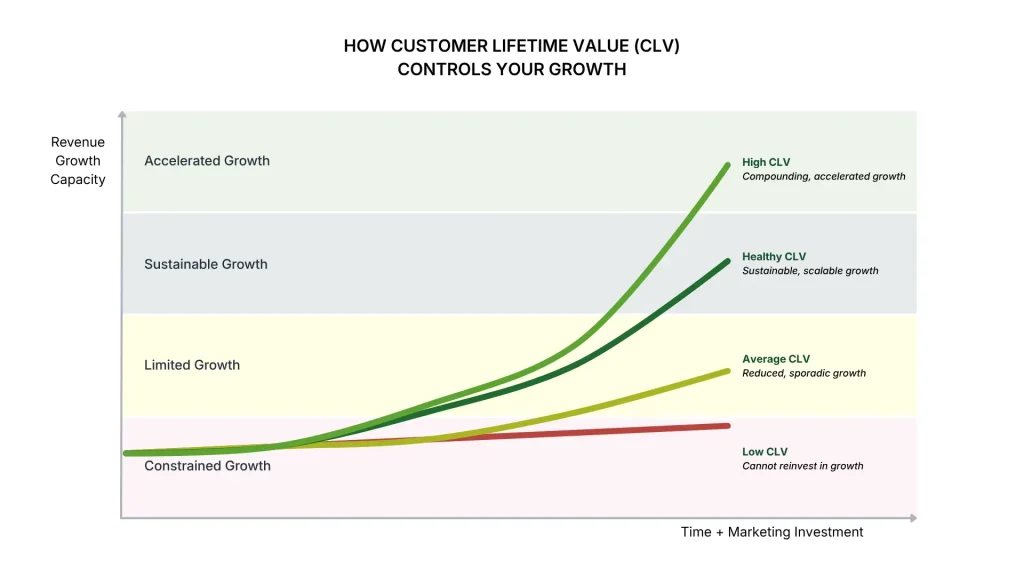
High CLV gives you options.
- You can scale faster.
- You can outspend competitors.
- You can be more aggressive.
Low CLV forces you to play small.
Which is why many businesses feel stuck even when the initial demand exists.
3. It drives profitability
Customer acquisition cost is paid upfront. Profit is realised over time.
Most businesses focus on the cost today, but don’t fully understand how that customer's value is realised over time.
CLV is a system, not just a static number
Customer lifetime value is not something you calculate once.
It is something you design:
- Through your pricing
- Through your customer experience
- Through your follow-up
- Through your marketing
CLV is planned before the sale, but created after it.
You influence it through your pricing, your positioning, and the products and offers you bring to market.
But it’s ultimately determined by what happens after the customer first says yes.
- The experience you deliver.
- The way you communicate.
- The systems you have in place to stay in contact and bring them back.
That’s where lifetime value is either built… or lost.
CLV vs CAC: The ratio that controls your growth
What is CAC?
Customer Acquisition Cost (CAC) is what you spend to acquire a new customer.
Spend too much on acquisition and you lose money. Spend to little and you cap your growth. The trick is to find the right balance.
The 3:1 benchmark
| CLV:CAC Ratio | Meaning | Risk Level |
| 1:1 | Losing money | Unsustainable |
| 2:1 | Risky | Fragile growth |
| 3:1 | Healthy | Scalable |
| 5:1 | Likely under-investing | Missed growth opportunity |
| ∞ (no paid acquisition) | Dangerously under-investing | Hidden growth ceiling |
If you are not actively spending to acquire customers, your CLV:CAC ratio is technically infinite.
That might sound ideal... it isn’t.
It usually means your growth is left to chance rather than controlled by strategy.
What you should be aiming for
A practical benchmark to grow a service businesses is to being able to invest 25–33% of your customer lifetime value to acquire a new customer.
If your business cannot support that, one of two things is true:
- Your margins are too thin
- Your lifetime value is too low
The payback period problem
A healthy CLV does not guarantee a healthy business.
You might have:
CLV: $6,000
CAC: $2,000
Ratio: 3:1
On paper, that looks strong.
But if that value is realised over 10 years, you could be waiting years just to recover your acquisition cost.
For most service businesses, that is not sustainable.
This is where smart businesses step back and use strategic planning to shift their model.
They shorten the payback period by:
- Increasing upfront value
- Pre-selling future work
- Structuring offers to recover acquisition costs faster
In simple terms, they move toward what’s often called client-financed acquisition.
Where the customer funds their own acquisition through early-stage value.
Not all customer lifetime value is created the same
Recurring revenue businesses
These businesses grow CLV through retention.
The longer a customer stays, the more valuable they become.
The focus is simple:
- Reduce churn.
- Increase retention.
Service-based businesses
Most service businesses rely on one-off jobs, or a "churn-and-burn" model.
Which means CLV is often lower than it should be.
In reality, CLV is created through:
- Repeat work
- Referrals
- Additional services
If you're currently reliant on “one-off jobs,” your CLV is artificially capped.
How to increase customer lifetime value (without more leads)
Here are 6 practical ways to increase customer lifetime value in a service business.
1. Optimise the first experience
The first job sets the tone for everything that follows.
Being proactive, clear, and consistent in how you communicate often has more impact than marginal improvements in technical delivery.
And this is where many businesses get it wrong.
Your administration and customer-facing staff play a critical role in how your business is perceived. This includes:
- How calls are taken.
- How updates are communicated.
- How problems are explained.
- How complaints are handled.
Training, supporting and rewarding positive behaviours in these areas often provide one of the highest return-on-investments you can make.
Customers who feel heard are more likely to stay, spend more over time, and refer others.
Giving customers a structured way to provide feedback also builds trust and strengthens the relationship.
2. Pre-book future work
Nothing is worse than looking at a bare calendar a week or two from now.
One of the simplest ways to increase customer lifetime value is to secure the next job before the current one is finished.
If a customer hesitates, offer a small incentive:
“If you’d like to lock this in today, we can offer 10% off when you leave a deposit.”
This shifts the dynamic:
- From uncertain future work
- To guaranteed future revenue
You’ve effectively turned a “maybe” into a committed customer.
The second booking is often the turning point between a one-off customer and a long-term client.
3. Build follow-up systems
Most businesses rely on memory.
Successful, scalable businesses rely on systems.
Simple follow-up messages, reminders and check-ins keep your business top of mind without being intrusive.
The key is consistency without additional effort.
The most effective follow-up systems are built using a CRM (Customer Relationship Management tool) with email and SMS automation, to stay in contact with customers at the right time.
This might include:
- Service reminders
- Post-job check-ins
- Seasonal prompts
- Relevant offers based on past work
Once this is set up properly, it runs in the background and ensures no customer slips through the cracks.
It’s one of the simplest ways to increase repeat work without increasing your workload.
4. Leverage reviews and reputation
Trust accelerates everything.
Most business owners already know more reviews increase lead-flow. But that’s only a fraction of what reviews can do.
Reviews don’t just bring in more customers.
They influence the type of customers you attract.
Reviews build a stronger reputation and that naturally attracts:
- More decisive buyers
- Higher trust from the first interaction
- Customers who are less price-sensitive
And that improves the type of customer you win.
These customers enter the relationship expecting to have a good experience.
They are more open, more trusting and more likely to notice the positive aspects of your service.
They are also more likely to engage.
To give feedback.
To leave a review.
To recommend you to others.
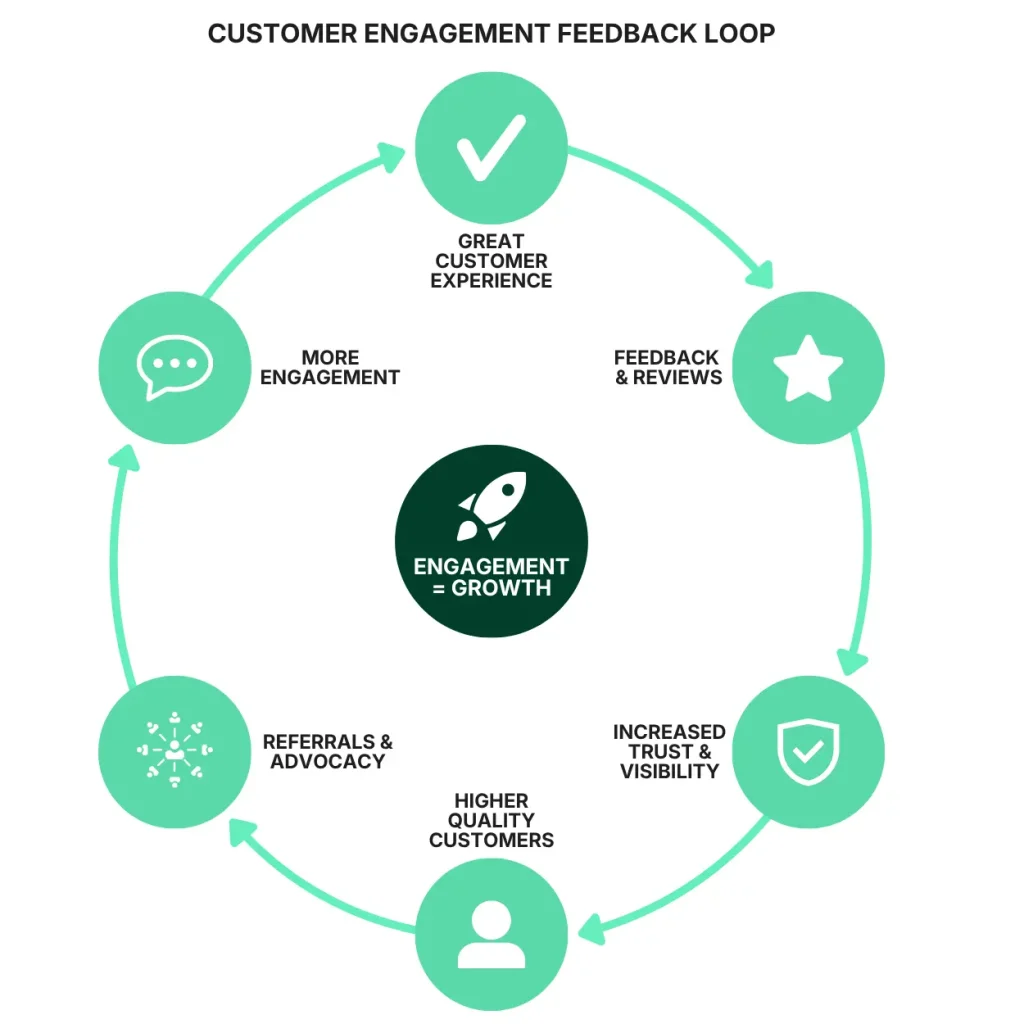
There is often a social expectation at play as well. When customers choose a highly reviewed business, they are more inclined to contribute to that reputation themselves.
But there’s another layer.
Customers who give feedback, leave reviews or refer others are more engaged.
And engaged customers are more valuable.
Customers who actively engage with a business by giving feedback, leaving reviews or referring others, generate 23% more revenue and profit over time than the average customer.
— Gallup
There’s also a psychological reason behind this.
When someone leaves a positive review, they are making a small public commitment.
And people naturally want to stay consistent with their own actions.
This is known as the Commitment and Consistency Principle, popularised by Robert Cialdini.
Once someone has publicly said, “this business is great,” they are more likely to:
Use you again
Recommend you to others
Publicly advocate for your business and influence others in your favour
In simple terms, reviews don’t just reflect a strong relationship.
Reviews strengthen the relationship.
And when you get more of your customers to leave reviews, it leads to:
- More repeat work
- More referrals
- A higher customer lifetime value.
The question is:
Are you getting reviews consistently… or leaving it to chance?
5. Create a value ladder
Most service businesses offer a series of one-off, parallel services.
A customer engages them for a single job on a project and that’s where the relationship ends.
Highly profitable businesses take a different approach.
They design a tiered progression of services and products, often referred to as a value ladder.
Instead of a single transaction, they create a pathway for customers to move through over time.
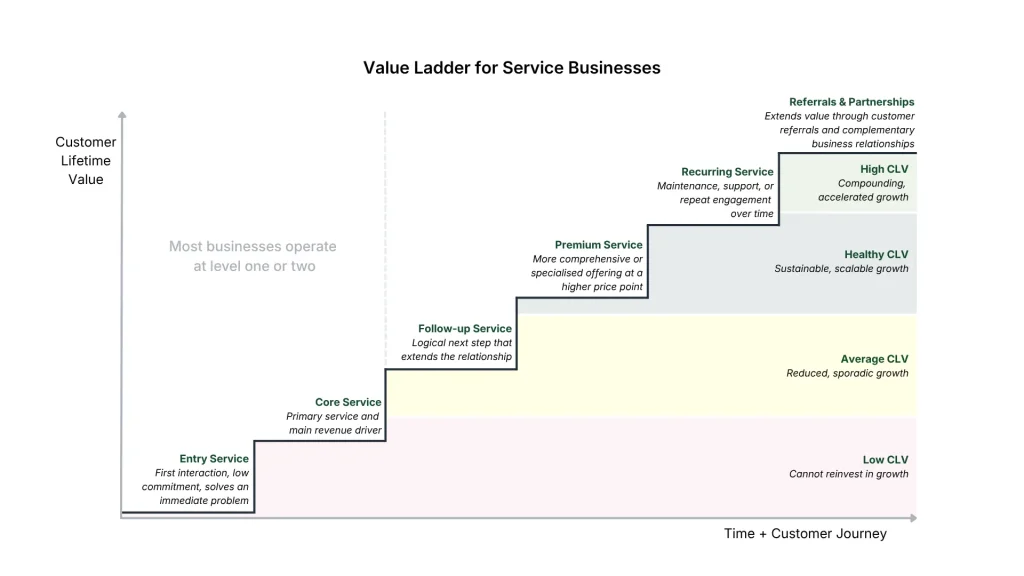
This shifts the relationship from one-off work to ongoing value.
And this is where lifetime value increases significantly.
Because once you’ve paid to acquire a customer, every additional service they purchase carries a much higher margin.
You’re no longer paying to win the customer again.
Which means more of that revenue goes straight to your bottom line.
A value ladder only works if you stay in contact with your customers.
As mentioned earlier, this is where simple follow-up systems become critical.
When you combine a clear value ladder with consistent follow-up, you create a scalable way to increase customer lifetime value without relying on memory or manual effort.
6. Build strategic partnerships
Strategic partnerships involve working with complementary, non-competing businesses that serve the same customer at different points in their journey.
There are two natural points where partnerships create value during a customer's journey:
1. During the customer relationship
At this stage, referrals enhance your service rather than replace it.
For example:
- A trades business referring a cleaner after a renovation
- An accountant referring a finance broker
- A physio referring a personal trainer
This improves the outcome for the customer and strengthens your position as a trusted provider.
2. At the end of your involvement
Every business reaches a point where it can no longer assist the customer.
At that point, the customer will either:
- Find another provider themselves
- Follow a trusted recommendation
When that recommendation comes from you, you stay part of the relationship rather than being replaced.
Why this increases customer lifetime value
Strategic partnerships don’t just help the customer. They improve your economics.
- Stronger trust leads to a higher likelihood of repeat work
- Better outcomes lead to more referrals
- Continued relationship leads to higher lifetime value
You’re not just completing a job.
You’re extending the relationship beyond it.
How partnerships are monetised
There are two common approaches.
| Model | How it works |
| Direct referral agreements | You receive a fee for connecting the customer to a trusted provider |
| Reciprocal partnerships | Both businesses consistently refer clients to each other |
In both cases, you increase the value of each customer without paying to acquire a new one.
Key takeaway
The goal is not to do everything for the customer.
It’s to become the business they trust to guide them.
Why customer lifetime value compounds over time
Retention drives profit
Increasing retention has a disproportionate impact on profitability.
Not because you’re doing more work. But because you’ve already paid to win the customer.
From that point on, every additional service, product or sale carries a much higher margin.
Which is why retention is one of the fastest ways to increase profit without increasing marketing spend.
The CLV growth loop
Referred customers:
- Trust you more
- Convert faster
- Stay longer
Because the trust has already been transferred.
Which means you spend less time convincing, and more time delivering.
That reduces your acquisition cost and increases the value of each customer.
Where customer lifetime value breaks down
Customer lifetime value breaks down when businesses miss the levers that actually drive it.
Here’s where it typically happens:
- They focus on getting more leads instead of increasing value per customer
- They ignore retention and follow-up
- They don’t understand their acquisition cost
- They treat every job as a one-off
- They fail to systemise the customer experience
These issues don’t always show up immediately.
But over time, they quietly cap your growth.
The question that determines how you grow
Customer Lifetime Value is not just a metric. It is the number that determines how aggressively your business can grow.
Most business owners are making that decision blind.
The question is not how many customers you can get. It’s "how much each customer is actually worth to your business" and "how can you increase their value further"?
Find out what’s actually holding your growth back
Without clear answers to these questions, most businesses don’t know where their quickest wins are.
- They don’t know which lever to pull first.
- They don’t know which change will have the biggest impact.
- And they don’t know what’s quietly limiting their growth.
That’s why we created the Business Growth Scorecard.
It’s an AI-powered diagnostic, built on real-world business growth frameworks, designed to give you the clarity of a $1,000 consulting session in under three minutes, without needing to speak to anyone.
Once complete, you’ll know:
- Where your biggest growth constraints are
- Which levers will have the fastest impact
- What to prioritise to increase revenue and profit
- How to start building a business that can grow without relying on you
In less than 3 minutes, it will help you identify where you’re stuck, what’s causing it and what to focus on next.
No guesswork.
Just a clearer path forward.
At some point, most business owners hit the same wall.
You’re working hard.
Things are moving.
Then you take your foot off the pedal… and it starts slipping backwards.
You’re still the bottleneck.
Growth feels temporary.
And there’s that quiet thought in the back of your mind:
"We should be further ahead by now."
That’s not a motivation problem.
It’s not even a lead problem.
It’s usually a signal that something deeper isn’t set up to support growth.
That’s exactly why we rebranded to Stryv Business Growth Partners and rebuilt our website from the ground up.
Not for the sake of change. But because the old branding and website no longer matched the level of work we were doing or the outcomes we were helping clients achieve.
Why We Rebranded
This wasn’t a cosmetic update.
It was a correction.
Our old name Stryv Business Development Partners had served its purpose.
But over time, it started to create friction.
Some business owners weren’t sure what “business development” actually meant.
Others assumed it was just about improving sales.
Neither was accurate.
Behind the scenes, the work had evolved.
We weren’t just helping businesses “develop”.
We were helping them grow. Structurally. Systematically. Sustainably.
We had clearer frameworks.
We had developed better systems.
And we had stronger understanding of what really moved the needle forward for our clients at each stage of their business.
The brand needed to reflect that.
Why “Growth” Changes Everything


The shift from development to growth wasn’t subtle. It was deliberate.
Growth is clear.
It means the business gets bigger. More profitable. More valuable.
The term "Growth" also sets an expectation.
When you partner with Stryv, the outcome is measurable business growth.
- Not more ideas
- Not more activity
- Not more noise
- Growth.
In reality, every business has multiple moving parts. In total, we have identified nine core pillars in business.
But only four-five of those pillars actually drive growth in a meaningful way.
And determining which pillars make the greatest impact depends on the stage of your businesses growth.
That’s where most businesses get stuck.
They spread effort across everything… instead of focusing on what actually compounds.
The Meaning Behind The New Brand
The colour change followed the same thinking.
The previous blue was solid. Trustworthy. Professional.
But it didn’t say growth.
The new brand centres around a deep forest green. It represents:
- Stability
- Structure
- A foundation strong enough to support long-term expansion

The lighter greens represent something different:
- New growth
- Expansion
- Momentum
Together, it tells a more complete story.
Not just growth for the sake of it.
It represents business growth that’s supported. Sustainable. Built to last.
Why Rebranding or Rebuilding Doesn’t Always Work
Here’s where most businesses go wrong.
They assume that rebranding their business or rebuilding their website will fix all of their problems. Sometimes it does. But often, it doesn’t.
That's because the issue isn't always the brand or the website.
Often the issue is that they look... sound... and operate like everyone else.
More specifically, they have a sameness problem.
Most businesses look at what their competitors are doing… then copy it.
- Same offers
- Same messaging
- Same channels
Maybe with slight tweaks.
They’re copying tactics without a clear strategic plan.
Over time, everything starts to look the same.
That leads to commoditisation—which creates a death spiral in business.
When that happens, price becomes the only real point of difference.
That’s where growth stalls.
And this is critical to understand. If the underlying strategy isn’t right, rebranding or rebuilding your website won’t fix the problem on its own.
But when the strategy is right, those decisions can accelerate everything.
What Stryv Actually Does
At its core, Stryv is about one thing.
Helping service businesses break through growth plateaus using smarter strategy and better systems.
That typically involves the four key pillars:
- Strategy and systems
- Marketing and branding
- Sales and prospecting
- Operations and client delivery
The goal is simple.
Focus on the few things that actually drive growth.
Build systems around them.
Then make them repeatable.
That’s how business growth sticks.
A Clear Path Forward (Instead of Guesswork)
One of the biggest changes behind the scenes was how we structure that journey.
Instead of a one-size-fits-all approach, we introduced three clear pathways:
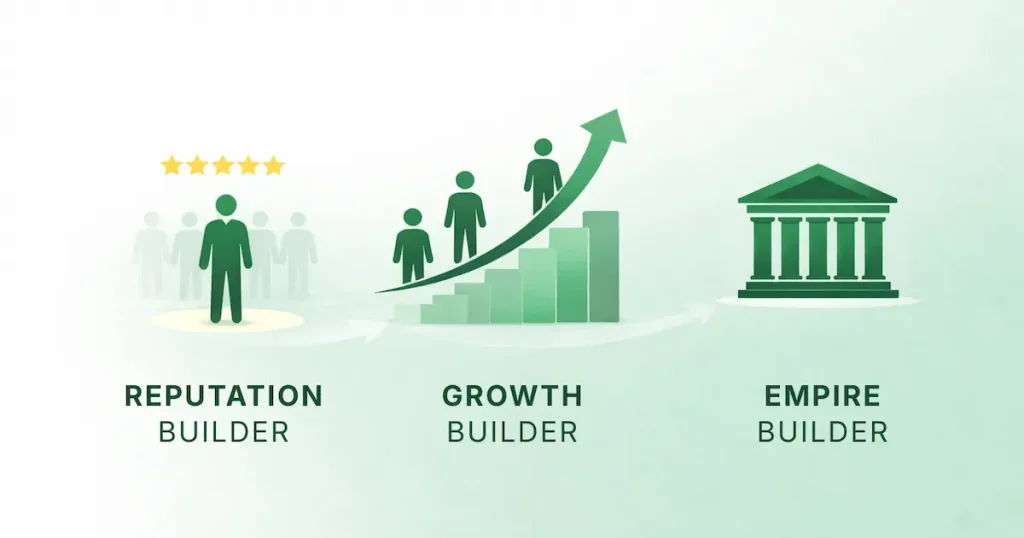
Each one is designed to meet your business where it is now… and move it to the next level.
This does two things.
- First, it gives you a clear place to start. You don’t need to fix everything at once.
- Second, it builds momentum. Early wins create confidence. Confidence creates commitment. Commitment drives bigger outcomes.
What Changed (and What Didn’t)
It is A lot has improved.
There’s more clarity.
Better structure.
Stronger frameworks.
It’s easier to see where you are.
And what needs to happen next.
But the fundamentals haven’t changed.
Business Growth Partners. What “Partners” means is still the same.
- We’re NOT consultants who hand over a plan and walk away.
- We’re NOT advisors who sit on the sidelines.
- We're NOT coaches who tell you what to do.
We work side-by-side with our clients.
- We embed directly into your business.
- We help physically implement the changes.
- We stay relentlessly focused on your results.
That level of involvement is what creates real results.
Why The Website Had To Be Rebuilt
The rebrand made one thing obvious.
The old website no longer fit for purpose.

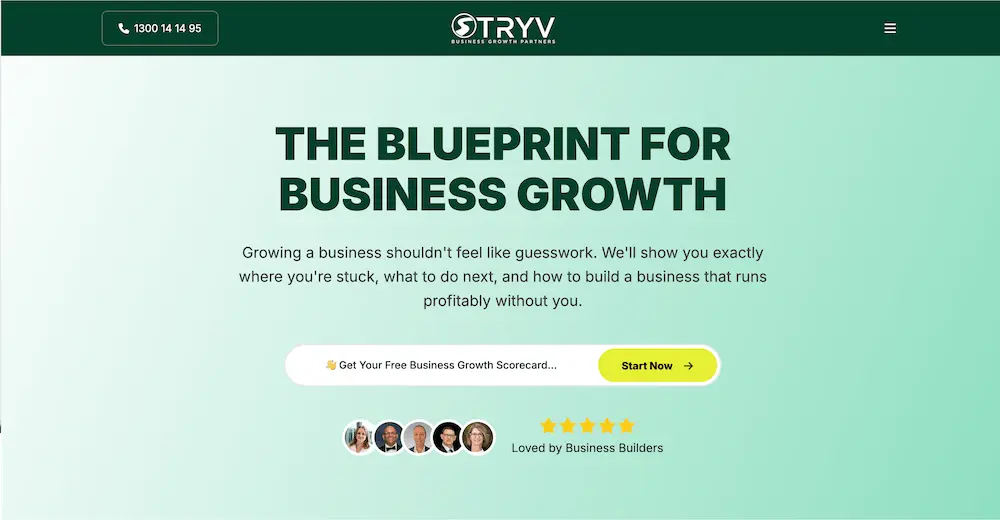
In truth, we had known for a while.
The old site was around six years old. And it was holding us back.
- It didn’t reflect the level of service we provide.
- It didn’t communicate our positioning clearly.
- It didn’t convert the way it should have.
It also lacked the infrastructure needed for long-term growth.
- No real content engine.
- Limited SEO capability.
- Weak trust signals.
- No structured way to generate leads at scale.
Every single page needed to be rethought... redesigned... rebuilt.
There was no shortcut.
This is also the same work we do for clients inside our Growth Builder service.
So it made sense to hold our own business to the same standard.
What This Means For Your Business
If you’ve been thinking about rebranding your business… or rebuilding your website… this is the real question:
Is your current brand or website supporting growth, or holding it back?
Because that’s what it comes down to.
- A rebrand on its own won’t fix a broken strategy.
- A new website won’t fix a weak offer.
But when those foundations are right, both can become powerful growth levers.
Sometimes the brand needs to catch up to the business.
Sometimes the website needs to catch up to the strategy.
And sometimes, like in our case, both need to happen at the same time.
The Bigger Picture
The goal isn’t just to grow revenue.
It’s to build a business that works.
- One that grows sustainably.
- One that doesn’t depend on you for every decision.
- One that becomes a real asset over time.
That requires more than tactics.
It requires alignment between strategy, systems, positioning and execution.
That’s what this change represents.
Next Step
If any part of this resonated, it’s worth stepping back and asking a simple question:
What’s actually holding my business back right now?
Not on the surface.
But underneath.
If you want clarity on where your business is really at, the best place to start is with the Business Growth Scorecard.
In less than 3 minutes, it will help you identify where you’re stuck, what’s causing it and what to focus on next.
No guesswork.
Just a clearer path forward.
Most business owners are not stuck because they lack effort.
They are stuck because they are doing too many things that do not move the business forward.
Busy days. Full calendars. Constant activity.
But little real progress.
That is where strategic vs tactical planning becomes critical.
To grow beyond the plateau, you need both a clear strategic plan and the right tactical execution. Most businesses only have one, and that is where things start to break down.
Think of it like this.
- Your strategy sets the destination. It defines where you want the business to be in three, five or even ten years.
- Your tactics are the step-by-step actions that get you there. They determine what needs to happen this week, this month and today.
Without strategy, your tactics are scattered.
Without tactics, your strategy is just an idea.
When the two are not aligned, you end up working hard without moving forward.
What is a Strategic Plan?
A strategic plan is the big picture roadmap for your business. It is about defining where you want to be in the future and setting the direction that will take you there. A good strategic plan is not a document that gathers dust on a shelf. It is a living guide that helps you and your team make consistent decisions with the long term in mind.
At its core, a strategic plan usually includes:
- Mission: Why your business exists
- Vision (Primary Objective): Where you want to be in 3–5 years
- Values: The principles that guide how you operate
- Goals (Secondary Objectives): Clear, measurable outcomes that show you are on track
The key is that a strategic plan looks forward. It asks, "Where do we want to be?" and then defines what success will look like once you arrive.
Example of a Strategic Business Plan
Imagine you run a local service business with ten staff. Your vision (primary objective) might be: "To become the leading provider in our region, known for outstanding customer service, within five years."
To support that, your goals (secondary objectives) could include:
- Growing annual revenue from $750K to $1.2M in three years
- Reducing the owner's hours in client work from 40 to under 15 per week
- Achieving 200 Google reviews with a 4.9-star average
- Winning an Outstanding Customer Service award from the local Chamber of Commerce
- Expanding into a second location by year five
These goals frame the backbone of the strategic plan. They are broad enough to set clear direction, but specific enough to measure progress.
What is a Tactical Plan?
If a strategic plan sets the destination, a tactical plan maps out the step-by-step actions that will get you there. It is the short-term execution layer that connects the big picture vision to the daily work happening in your business.
A tactical plan usually includes:
- Initiatives: Specific projects that support a secondary objective
- Actions: The tasks that sit inside each initiative
- Timelines: When initiatives and actions will be completed
- Resources: The people, tools and budget required
- KPIs: The measurable indicators that show progress is being made
For example, let's say your strategic goal is to grow annual revenue from $750K to $1.2M in three years. One of the tactical plans supporting this goal might focus on improving your sales conversion rate by 10% in the next six months. Within that tactical plan, you could have several initiatives, such as:
- Developing an enhanced sales script and training staff
- Introducing a smart enquiry form using conditional logic to qualify prospects more effectively
- Setting up an automated email sequence to nurture leads who are not ready to buy straight away
Each initiative then breaks down into its own set of actions. For example, building a new enquiry form requires mapping the logic, creating the form, testing it and training staff on how to use it.
This shows how tactical planning is . A strategic goal can generate several tactical plans, each multi-layered tactical plan may contain multiple initiatives and each initiative will require a series of detailed actions to bring it to life.
While the strategy answers "Where do we want to be?” the tactics answer “What do we need to do now to get there?". Tactical planning is usually done in shorter cycles, often 90 days, so you can focus on clear actions, review results quickly and adjust as needed.
And here is the important thing: while the logic is simple, the execution is complex. Pulling it all together, aligning goals, creating initiatives, breaking them into actions and keeping everything on track is easier said than done. This is exactly where many businesses benefit from outside support.
Army Planning in Business Strategy
I first learned the importance of planning while serving as an officer in the Army. Before every mission we went through the . This process involved assessing the environment, Military Appreciation Process (MAP) understanding the mission objective and then reverse-engineering the steps needed to achieve success.
The mission objective was always clear. Everything depended on whether or not we achieved it. To do that we worked backwards from the objective, breaking it down into secondary objectives and then into specific actions. It was always easier to start from the end point and trace back to the beginning rather than start from the beginning and try to plan forwards.
This is the same in business. You need a clear primary objective, ideally a . From there you can break SMART goal it into secondary objectives or markers along the way. Each of those secondary objectives can then be broken down further into tactical plans and the step-by-step actions that drive progress.
Every strategic plan is made up of multiple tactical plans, and every tactical plan is made up of layers of initiatives and actions. By working backwards from the objective you create a direct line to success instead of wandering aimlessly hoping you will arrive at the right place.
Why Reverse-Engineering Plans is the Key
Another way to understand reverse engineering is to picture a tree branch. Start at the very tip of a branch and trace it back toward the trunk. You will always follow the exact path that leads back to the starting point. It is the quickest and most efficient route because you are working backwards from the known objective.
Now imagine starting from the trunk instead. There are many branches and twigs that head in different directions, and most of them do not lead to where you actually want to go. If you try to plan forwards, you will almost always take a wrong turn and end up somewhere you did not intend. This is why working backwards from your objective is so powerful. It eliminates wasted effort, reduces confusion and keeps you aligned with your destination.
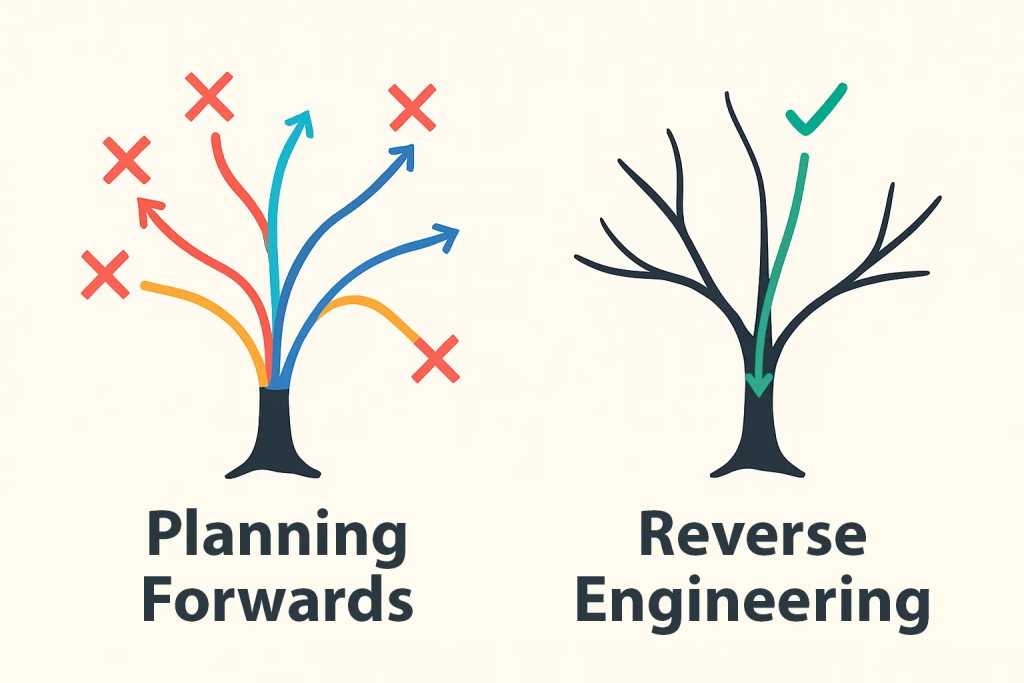
In business, the tip of the branch is your strategic goal. The path back toward the trunk is your tactical plan. By working backwards you can see the exact steps required to reach your goal instead of guessing which branch might take you there.
Strategic vs Tactical Planning: Key Differences
By now you can see that strategic and tactical planning are different but connected. To make the distinction clearer, let's break them down side by side.
| Strategic planning | Tactical planning |
| Sets the destination | Maps the step-by-step actions to get there |
| Long-term focus (3–5 years or more) | Short-term focus (90 days to 12 months) |
| Unites the primary objective | Breaks it into secondary objectives and actions |
| Big picture, directional | Detailed, executional |
| Driven by owners and leaders | Executed by managers and teams |
| Answers "Where do we want to be?" | Answers "What do we need to do now?" |
Strategic sets the destination. Tactical maps the actions to get there.
The two are not interchangeable. A business with only a strategy has direction but no movement. A business with only tactics is constantly moving but often in circles. When you put both together you get clarity, focus and momentum.
Why You Need Both (Not Just One)
It is common for business owners to lean too heavily in one direction. Some focus only on big picture strategy. They talk about their vision and long-term goals but never break them into the actions required to make them happen. Others stay busy with day-to-day tactics but have no clear destination. They confuse activity with progress.
Both approaches are flawed.
- Strategy without tactics is like having a destination marked on a map but no roads drawn to get there. You know where you want to go, but you will never arrive.
- Tactics without strategy is like driving around aimlessly. You are burning energy and covering distance but not actually moving closer to where you want to be.
When you combine both, strategy provides direction and tactics provide momentum. One gives you clarity, the other gives you traction. Together they keep you moving forward with purpose.
How Strategic and Tactical Plans Work Together
The real power comes when you link your strategic plan with your tactical plans. Think of it as a cascade.
- Start with the primary objective (vision). For example, becoming the leading service provider in your region within five years.
- Break it into secondary objectives (goals). These could include increasing revenue, reducing the owner's workload, or achieving 200 Google reviews.
- Develop tactical plans for each secondary objective. Each tactical plan contains multiple initiatives and actions that bring the goal closer to reality.
For example, if one of your strategic goals is to expand into a second location within five years, a tactical plan might include:
- Researching demand in potential new areas
- Securing financing and preparing a cashflow forecast
- Recruiting and training the first hire for the new location
- Running targeted marketing campaigns in the new service area
Each of these initiatives can then be broken down into smaller, step-by-step actions with timelines, resources and KPIs attached.
This creates a direct link between what you do today and where you want the business to be tomorrow. It also creates a feedback loop. As you implement tactics and track results, you can refine your strategy. Sometimes the data shows you need to adjust your approach. Other times it confirms you are right on course.
When done well, strategic and tactical planning work like gears in a machine. The big gear sets the direction, the small gear turns every day to move you forward. Without one, the other does not work.
Common Mistakes Business Owners Make
Even with the best intentions, many business owners fall into common traps when it comes to planning. Here are some of the most frequent ones:
- Confusing tactics for strategy
Saying "our strategy is Facebook ads" is not a strategy. That is a tactic. Without a clear destination, even the best tactic will fail to deliver meaningful progress. - Not updating the plan as the business grows
A strategic plan is not set in stone. Markets change, competitors adapt and your own priorities evolve. What made sense three years ago might no longer be relevant today. - Micromanaging tactics without strategic clarity
Some owners dive deep into the weeds of daily actions without remembering why those actions matter. This often creates busyness instead of real progress. - Setting vague or unrealistic goals
Goals like "grow the business" or "get more clients" provide no direction. Effective goals need to be SMART: specific, measurable, achievable, relevant and time bound. - Chasing shiny objects
Many business owners are easily distracted by the next new tool, marketing technique or software platform. Sometimes it comes from a persuasive social post, other times from a trending Facebook post, or even a vocal client or staff member making noise about what "needs" to be done. The danger is that attention shifts away from the plan, resources are spread too thin and momentum toward real objectives is lost. - Trying to do everything themselves
Pulling together strategy and tactics is a lot of work. Without external accountability or a proven framework, many business owners lose momentum or abandon the plan entirely. Accountability also helps maintain focus. It prevents you from being distracted by shiny objects or from being pulled off course by loud clients or staff with competing priorities.
Being distracted or losing focus can be just as damaging as not having a plan at all. Avoiding these mistakes is just as important as setting the right direction. A good plan only works if it is clear, realistic and consistently implemented.
Keeping Your Plan on Track: My Success Journal Method
Even the best plans fail without a simple system to keep you accountable and track progress over time. Over the years I have developed a simple system that keeps my strategic and tactical plans aligned: a method I call the Success Journal Method.
- Annual planning
Once I have determined my secondary objectives and the tactical plans that support them, I assign realistic timeframes. I then enter these into my annual success journal. This gives me a clear reference point for what I want to achieve during the year. - Monthly review
At the end of each month I assess how I went in achieving that month's goals. I use those insights to adjust and reset the goals for the next month. Each month gets its own set of objectives recorded in the journal. - Daily focus
Each day I plan my work by prioritising the most important tasks, the ones that directly help me achieve my monthly and annual goals. This daily discipline ensures I am always working on what matters most, not just what feels urgent. - Year-end reset
At the end of the year I reflect on the progress made. I then adjust my strategic goals and tactical implementation for the year ahead. This keeps me consistently moving toward my long-term vision without losing sight of the bigger picture.
The benefit of this system is that it keeps me accountable to myself and to the plan. It stops me from drifting, chasing shiny objects or forgetting what I am working toward. Most importantly, it creates momentum. Every day, every month and every year builds on the last.

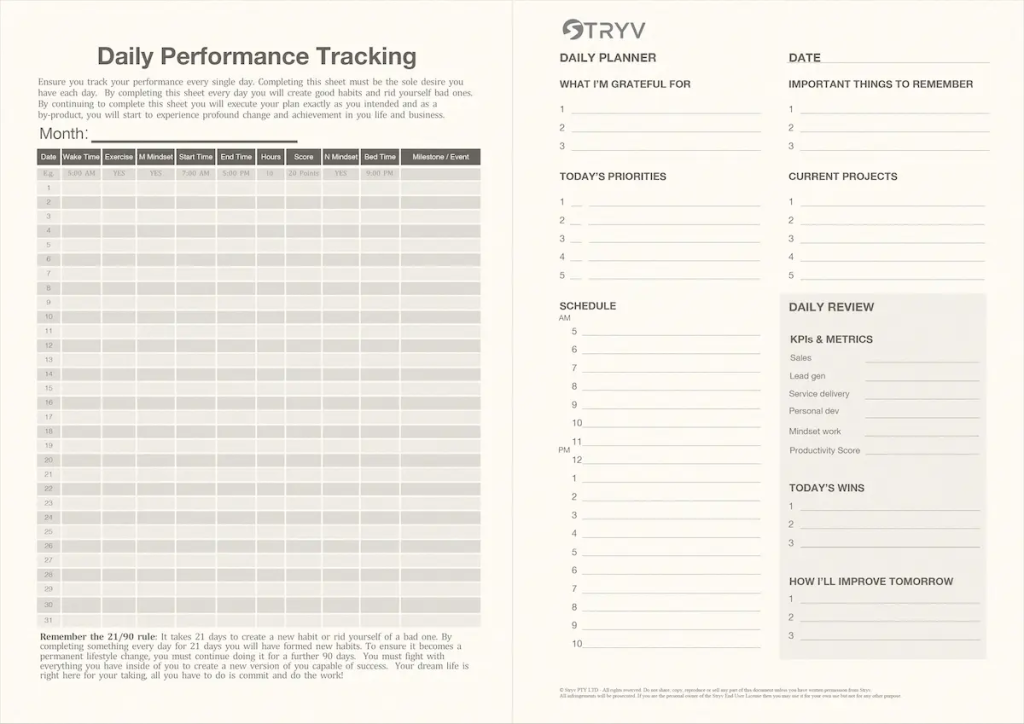
Annual and monthly reviews, weekly planning and daily performance tracking.
How to Build Your Own Strategic and Tactical Plans
By now you can see that strategy and tactics are two sides of the same coin. The question is, how do you put them together into a workable plan for your own business? Here is a simple process to follow:
- Define your primary objective (vision)
Start by deciding where you want the business to be in three to five years. Make it a SMART goal so it is specific, measurable, achievable, relevant and time bound. - Break it into secondary objectives (goals)
Identify the key milestones that will mark progress toward your vision. These might include revenue targets, customer experience outcomes, operational improvements or recognition such as winning an Outstanding Customer Service award from your local Chamber of Commerce. - Create tactical plans for each goal
For every secondary objective, build one or more tactical plans. Each plan should include initiatives, actions, timelines, resources and KPIs. Think in 90-day cycles so you can review and adjust regularly. - Assign accountability
Designate who is responsible for each initiative and action. Accountability ensures tasks do not get lost in the busyness of day-to-day operations. - Track progress
Use a system like my Success Journal Method or a project management tool to keep your plans visible and on track. Regularly review your progress against both the strategic and tactical levels.
This process is straightforward in theory but challenging in practice. It requires clarity, consistency and discipline. Many business owners find that while they can set a direction, they struggle to maintain focus, avoid distractions and keep the tactical work aligned with the strategy. That is why external support and accountability often make the difference between a plan that sits on a shelf and a plan that actually delivers results.
Conclusion
Every successful business needs both a strategic plan and a tactical plan. The strategy sets the destination. The tactics map the step-by-step actions to get there. One without the other leaves you either standing still or running in circles.
From the Military Appreciation Process I used in the Army, to the concept of reverse engineering your goals, to my own Success Journal Method, the lesson is the same. Start with a clear objective, work backwards to create secondary objectives, then break those into tactical plans and daily actions. This is how you create alignment, clarity and momentum.
Remember, every strategic plan is really a collection of tactical plans. Every tactical plan is made up of layers of initiatives and actions. When you link them together, you build a direct path from where you are now to where you want to be.
You now understand the difference between strategy and tactics. The real question is, do you actually have both working together in your business?
Most business owners don’t.
They either:
- Have a rough idea of where they want to go, but no clear plan to get there.
- Or they are busy executing day to day without knowing if it is moving them in the right direction.
That is why businesses get stuck.
They are not lacking effort. They are lacking alignment.
If you want clarity on where your business is really at, the best place to start is with the Business Growth Scorecard.
It takes less than 3 minutes and gives you a personalised breakdown of:
- Where your growth is being held back.
- What is working.
- What needs to change next.
Because until your strategy and tactics are aligned, growth will always feel harder than it should.
If you would like to see exactly where your business stands, start your free Business Growth Scorecard today.


